

Coding and Marking Equipment Market to Reach USD 8.25 Billion by 2035 at 6.2% CAGR
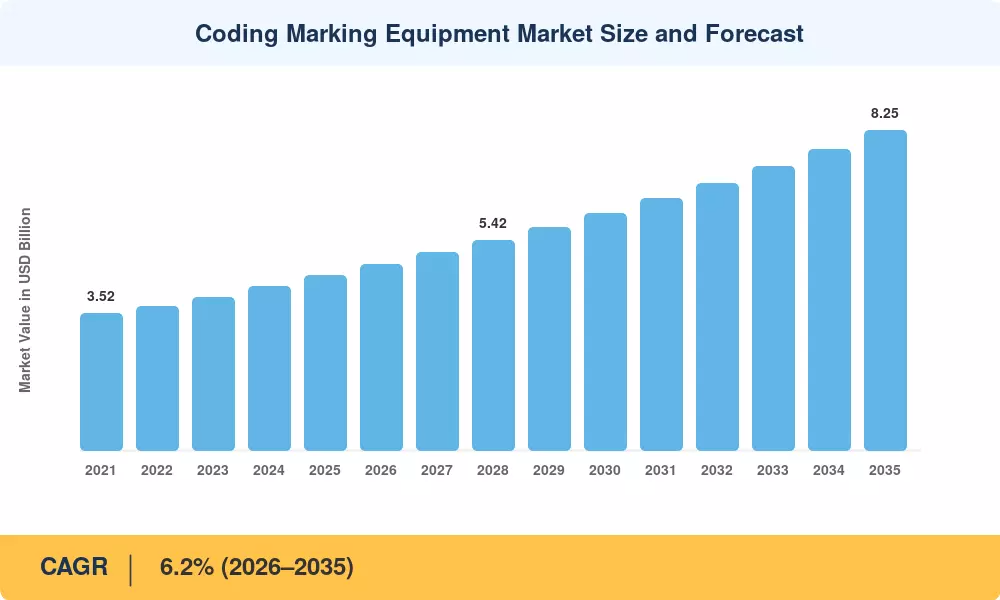
Coding and Marking Equipment Market
The global Coding and Marking Equipment Market reached an estimated USD 4.52 billion in 2025 and is projected to grow from USD 4.80 billion in 2026
The global Coding and Marking Equipment Market reached an estimated USD 4.52 billion in 2025 and is projected to grow from USD 4.80 billion in 2026 to USD 8.25 billion by 2035”
NEW YORK, NY, UNITED STATES, July 27, 2026 /EINPresswire.com/ -- The global Coding and Marking Equipment Market reached an estimated USD 4.52 billion in 2025 and is projected to grow from USD 4.80 billion in 2026 to USD 8.25 billion by 2035, registering a CAGR of 6.2% during the forecast period (2026–2035).— Arti Dhapte
Market Overview
Coding and marking equipment encompasses a diverse range of industrial printing and labeling systems designed to apply variable information—including batch numbers, expiration dates, barcodes, serial numbers, and product descriptions—onto products, packaging, or labels . This essential machinery includes continuous inkjet (CIJ) printers, laser coders, thermal inkjet (TIJ) systems, thermal transfer overprinters (TTO), large character inkjet printers, and label applicators . These technologies are foundational to modern manufacturing and logistics, enabling traceability, compliance, and brand protection across virtually every packaged goods industry.
The market's robust growth is driven by two powerful catalysts: tightening product traceability regulations under the EU Falsified Medicines Directive and the U.S. Drug Supply Chain Security Act (DSCSA), and a global packaging output surge driven by e-commerce volumes that exceeded USD 6.3 trillion in 2024 . The Coding and Marking Equipment Market sits at the intersection of regulatory compliance and operational efficiency, making it resilient across economic cycles.
Industry trends indicate a substantial technological transformation from legacy contact-based printers—such as roller coders and hot stampers—to non-contact inkjet and laser systems offering higher throughput, variable data capability, and lower per-mark cost . Manufacturers prioritizing Industry 4.0 integration resulted in a 12% year-on-year increase in capital expenditure on digital coding platforms in 2024, surpassing USD 1.9 billion globally . Cloud-connected coding platforms now enable remote diagnostics and real-time line monitoring, reducing unplanned outages by as much as 30% in early adopter facilities .
Technological developments are reshaping the coding landscape. The integration of machine-vision inspection with coding platforms creates closed-loop systems that identify misprints in real time . AI-driven autonomous coding operations will optimize print-head performance and manage predictive maintenance schedules, effectively addressing the estimated 80 million worker shortage in digital-skills-reliant sectors . Digital twin technology allows manufacturers to simulate production line configurations before physical deployment, reducing commissioning time by up to 60% .
Policy and regulatory influence on the market is substantial and growing. The U.S. Drug Supply Chain Security Act reached full enforcement in late 2024, mandating item-level serialization to secure the pharmaceutical supply chain . Similarly, the EU Falsified Medicines Directive requires unique identifiers on outer packaging to prevent counterfeit infiltration . The EU Packaging and Packaging Waste Regulation, in force since February 2025, mandates that all packaging must be recyclable by 2030, driving demand for laser marking and bio-based inks .
The demand outlook remains exceptionally positive, with the market poised for consistent double-digit investment growth through 2035. North America dominates the market with an approximate 32% revenue share, attributed to mature food-safety infrastructure and stringent FDA serialization mandates . Asia-Pacific is the fastest-growing region with a projected CAGR of 7.8%, propelled by mandatory product traceability standards in China and expanding pharmaceutical manufacturing in India . Europe maintains the second-largest share at approximately 27%, based on harmonized GS1 standards and EU Green Deal packaging reforms .
📍 Get Free Sample Report for Detailed Market Insights:
https://www.marketresearchfuture.com/sample_request/30570
Market Segmentation
By Technology
The coding and marking equipment market is segmented by technology into Continuous Inkjet (CIJ), Laser Coding, Thermal Inkjet (TIJ), Thermal Transfer Overprinter (TTO), Large Character Inkjet, Label Applicators, and Others (Hot Stamping, Pad Printing). Continuous inkjet (CIJ) technology holds the largest share at approximately 38% of 2025 revenue, driven by versatility across substrates and high-speed lines exceeding 1,000 units per minute . CIJ's ability to print on virtually any substrate—glass, plastic, metal, cardboard—gives it unmatched flexibility for beverage, dairy, and personal-care applications . Laser coding systems are the fastest-growing technology segment, registering a CAGR of 8.1% through 2035 as manufacturers seek consumable-free permanent marking solutions . Thermal transfer overprinter (TTO) systems account for an estimated USD 0.52 billion in 2025, anchored by flexible packaging demand . Thermal inkjet systems have carved a strong niche in pharmaceutical serialization, where high-resolution 2D codes must be printed at line speeds of 200–400 packs per minute .
By End-Use Industry
End-user segmentation covers Food & Beverage, Pharmaceutical & Healthcare, Automotive & Aerospace, Electronics & Semiconductors, Cosmetics & Personal Care, and Industrial & Chemical. Food and beverage remains the dominant end-use vertical, representing roughly 36% of total demand, driven by mandatory date-of-manufacture, best-before, and lot codes on every consumer unit . The pharmaceutical sector is the fastest-growing end-use vertical at a CAGR of 7.4%, as serialization requirements cascade across emerging markets . Automotive and aerospace represent USD 0.41 billion in 2025, driven by component traceability requirements . Electronics and semiconductors require micro-marking capabilities, representing approximately 9% of market share . Cosmetics and personal care grow at 5.8% CAGR, driven by brand-protection coding requirements .
By Application
Application segmentation includes Primary Coding, Secondary Coding, and Tertiary Coding. Primary coding dominates the market at approximately 48% share, as every individual product unit requires at least one mark—whether a date code on a bottle cap or a serialized DataMatrix on a pharma carton . Secondary coding represents the fastest-growing application segment at 6.9% CAGR, as aggregation requirements tighten and brands must link individual unit codes to case-level identifiers for full chain-of-custody visibility . Tertiary coding accounts for USD 0.38 billion in 2025, serving pallet and logistics marking requirements .
By Region
Regional segmentation includes North America, Europe, Asia Pacific, South America, and the Middle East and Africa. North America leads the market with an estimated USD 1.45 billion in 2025 revenue . Europe holds the second-largest position, supported by strict traceability legislation . Asia-Pacific is the fastest-growing region at 7.8% CAGR, with China and India representing more than 60% of regional demand . South America represents USD 0.32 billion in 2025, driven by food-export traceability . The Middle East and Africa grows at 6.5% CAGR, supported by Halal certification coding requirements .
🛒 You can buy this market report at:
https://www.marketresearchfuture.com/checkout?currency=one_user-USD&report_id=30570
Regional Analysis
North America
North America dominates the Coding and Marking Equipment Market with an approximate 32% revenue share, anchored by DSCSA full enforcement and the FDA's evolving food-traceability rule under FSMA Section 204 . The United States accounts for approximately 78% of regional revenue, with manufacturers increasingly replacing aging CIJ fleets with hybrid laser-inkjet cells offering both high-contrast coding on primary packaging and case-level marking . Canada grows at a CAGR of 5.9%, driven by cannabis serialization requirements for child-resistant packaging . Mexico benefits from nearshoring trends drawing multinational FMCG production capacity south of the border, contributing USD 0.07 billion in 2025 .
Europe
Europe holds the second-largest position in the market at approximately 27% share, shaped by the dual forces of the Falsified Medicines Directive and the Packaging and Packaging Waste Regulation . Germany leads regional spending at approximately 24% of European revenue, with its automotive sector requiring permanent laser-marked traceability codes on safety-critical components . The United Kingdom grows at 5.7% CAGR, with post-Brexit regulatory divergence creating parallel compliance requirements prompting dual-coding installations . France's pharmaceutical sector—Europe's largest by export volume—drives sustained demand for high-resolution serialization systems, contributing USD 0.14 billion in 2025 .
Asia-Pacific
Asia-Pacific represents the primary growth engine for the Coding and Marking Equipment Market with a 7.8% CAGR, where China and India represent more than 60% of regional demand . China accounts for approximately 35% of regional revenue, with its State Administration for Market Regulation intensifying food-safety code requirements across the country's 450,000+ food-processing facilities . India is the fastest-growing major market with a CAGR of 9.2%, as pharmaceutical export serialization mandates catalyze a multi-year equipment upgrade cycle across an estimated 8,000 manufacturing sites . Japan contributes USD 0.18 billion in 2025, with its electronics sector demanding ultra-fine laser marking for semiconductor and component traceability .
Rest of the World
The Rest of the World segment, encompassing South America, the Middle East, and Africa, presents developing market opportunities. Brazil anchors the South American market with approximately 62% of regional revenue, where Anvisa's pharmaceutical serialization system mandates unique device identification across all marketed drugs . Argentina grows at 6.0% CAGR, driven by agricultural export coding requirements . Saudi Arabia accounts for approximately 30% of Middle East and Africa regional revenue, with Vision 2030 driving food and pharmaceutical manufacturing localization . The UAE grows at 7.1% CAGR, requiring multilingual coding and aggregation capabilities to meet diverse destination-country regulations .
Competitive Landscape / Key Players
The Coding and Marking Equipment Market is moderately concentrated, with the top five players accounting for an estimated 52–58% of global revenue . Key companies operating in this market include Danaher Corporation (Videojet), Dover Corporation (Markem-Imaje), Brother Industries (Domino), Hitachi Industrial Equipment, SATO Holdings, and Matthews International . Other significant players include Paul Leibinger, ICE (Industrial Coding & Electronics), Squid Ink Manufacturing, and KGK Jet India .
Strategic developments in the market include significant product launches and software innovations. In May 2026, Markem-Imaje launched CoLOS® Version 7, a comprehensive software suite designed to enhance automation, industry compliance, and security for organizations managing multiple production lines . Domino Printing Sciences expanded its laser marking portfolio in June 2026 to better support high-speed packaging requirements within the food, beverage, and pharmaceutical industries across global markets . Control Print Limited continued leveraging its strategic acquisition of Codeology Group in March 2026 to integrate high-capacity inkjet printing technology .
Competitive differentiation increasingly hinges on software ecosystem depth, service-network coverage, and consumable lock-in rather than hardware specifications alone . Danaher's Videojet offers the broadest technology portfolio with a global service network . Dover's Markem-Imaje provides strong pharmaceutical serialization platforms . Brother Industries' Domino focuses on innovation-led cloud connectivity .
Latest Industry News & Developments
Recent industry developments highlight the ongoing transformation of the coding and marking equipment market toward digitalization and sustainability. Markem-Imaje launched CoLOS® Version 7 in May 2026, a comprehensive software suite designed to enhance automation, industry compliance, and security for organizations managing multiple production lines. This development reflects the industry's pivot from hardware-centric models to software-defined ecosystems.
Domino Printing Sciences expanded its laser marking portfolio in June 2026 to better support high-speed packaging requirements within the food, beverage, and pharmaceutical industries across global markets. The expanded portfolio addresses growing demand for consumable-free marking solutions as manufacturers seek sustainable, cost-effective coding alternatives.
Control Print Limited continued leveraging its strategic acquisition of Codeology Group in March 2026 to integrate high-capacity inkjet printing technology, specifically enhancing its large-surface coding and labeling capabilities. This acquisition reflects the trend toward consolidation and technology integration in the market.
Market Challenges & Opportunities
Key restraints facing the coding and marking equipment market include the high initial capital cost of laser systems, which for small and medium enterprises often exceeds standard budgetary allocations for production line equipment . Ink and consumable supply-chain disruptions expose manufacturers to significant vulnerabilities, with raw material transit times increasing by up to 14 days . Fragmented regulatory standards across regions create substantial operational complexity for international pharmaceutical exporters, necessitating redundant system configurations . A skilled operator shortage for advanced platforms, with an estimated 80 million worker shortage in digital-skills-reliant sectors, constrains adoption . Slow adoption among small and medium enterprises in emerging markets further limits growth .
Emerging opportunities in the market are substantial and diverse. Cloud-based coding-as-a-service models are pivoting equipment vendors to subscription-based offerings, bundling hardware, consumables, and cloud monitoring into a single monthly fee . This strategy converts capital expenditure into operating costs, enabling small and medium enterprises to access automated coding . Sustainable packaging and ink innovation present significant opportunities, as the EU Packaging and Packaging Waste Regulation mandates recyclable packaging by 2030, driving demand for laser marking and bio-based inks . Emerging-market pharmaceutical manufacturing expansion, with India's domestic pharmaceutical market expected to hit USD 130 billion by 2030, mandates advanced serialization-grade coding equipment across thousands of new sites .
Future potential lies in AI-driven print quality inspection, where integrating machine-vision with coding platforms creates closed-loop systems that identify misprints in real time . Platform consolidation and software ecosystems are transitioning the industry from hardware-centric to software-defined models, with open-API architectures integrating coding platforms with enterprise resource planning systems . Digital twin integration for line optimization allows manufacturers to simulate production line configurations before physical deployment, shifting purchasing decisions from initial unit price toward long-term system performance and total operational efficiency .
To explore more market insights, visit us at:
https://www.marketresearchfuture.com/reports/coding-marking-equipment-market-30570
Final Market Summary
The coding and marking equipment market is positioned for robust growth through 2035, driven by tightening regulatory serialization mandates, e-commerce packaging volume growth, and accelerating Industry 4.0 integration. The projected valuation of USD 8.25 billion reflects sustained demand across food and beverage, pharmaceutical, automotive, and electronics sectors, with the market transitioning from legacy contact-based systems to non-contact, digital, and cloud-connected platforms.
The medium-term growth outlook remains exceptionally strong, with the market registering a CAGR of 6.2% during the forecast period. North America will continue to maintain market leadership through mature food-safety infrastructure and stringent FDA regulations, while Asia-Pacific emerges as the fastest-growing region driven by mandatory traceability standards and pharmaceutical manufacturing expansion. The ongoing development of laser coding technology, AI-driven inspection systems, and cloud-based service models will continue to expand market possibilities and applications.
Long-term industry potential extends significantly beyond the current forecast horizon. The convergence of regulatory mandates, digital transformation imperatives, and sustainability requirements will continue to reshape the market landscape. Platform consolidation and software ecosystems will integrate coding platforms with enterprise systems, creating interconnected, data-rich value chains. Sustainability as a competitive differentiator will drive adoption of solvent-recovery modules and energy-efficient marking technologies. Manufacturers that successfully develop software-defined, cloud-connected solutions, invest in AI-driven quality inspection, and address regulatory compliance across multiple regions will capture substantial value in this rapidly evolving market. The transformation of coding equipment from standalone printers to intelligent networked data nodes represents one of the most significant developments in industrial packaging and traceability, fundamentally changing how manufacturers ensure product integrity, safety, and supply chain visibility.
More Related Reports from MRFR Library:
Fire Rated Ducts Market: https://www.marketresearchfuture.com/reports/fire-rated-ducts-market-10414
Zero Turn Mowers Market: https://www.marketresearchfuture.com/reports/zero-turn-mowers-market-10890
Residential Boiler Market: https://www.marketresearchfuture.com/reports/residential-boiler-market-10891
Injection Molding Machinery Market: https://www.marketresearchfuture.com/reports/injection-molding-machinery-market-10943
Safes Vaults Market: https://www.marketresearchfuture.com/reports/safes-vaults-market-11079
Mining Equipment Market: https://www.marketresearchfuture.com/reports/mining-equipment-market-11301
Commercial Water Filter Market: https://www.marketresearchfuture.com/reports/commercial-water-filter-market-11392
Chillers Market: https://www.marketresearchfuture.com/reports/chillers-market-11556
Gaskets And Seals Market: https://www.marketresearchfuture.com/reports/gaskets-and-seals-market-11627
Recycling Equipment Market: https://www.marketresearchfuture.com/reports/recycling-equipment-market-11732
Larry Wilson
WantStats Research And Media Pvt. Ltd.
+1 855-661-4441
email us here
Legal Disclaimer:
EIN Presswire provides this news content "as is" without warranty of any kind. We do not accept any responsibility or liability for the accuracy, content, images, videos, licenses, completeness, legality, or reliability of the information contained in this article. If you have any complaints or copyright issues related to this article, kindly contact the author above.
